Friday, March 15, 2013

Orange carrots

(Daucus carota)

Purple, white, and yellow carrots may look like strange new hybrids, but ancient civilizations from Europe to East Asia cultivated yellow and purple carrots. Today's "normal" orange carrots likely didn't become popular until the 1800s.

Image credit: Hflournouy1

The French developed many of today's popular heirloom carrot varieties including Oxhart, Nantes, St. Valery, and Chantennay. As you probably know, some carrot varieties grow short, making them more suitable for hard, clay soils, while other varieties are tough and burrow deeper into the soil.

Image credit: LCBGlenn

If you're still interested in purple, white, and yellow carrots (honestly, doesn't every gardener want to pick these from his garden?), you can find Burpee's Kaleidoscope Mix of colorful carrots at your local ChinaMart.While these seeds are open-pollinating and organic, I can't determine whether they are actually heirlooms as they seem like new varieties of the ancient plants. 

One word of warning: don't plan to transplant carrots as this can give you forked roots. Sow seeds outside three or four weeks before the last frost and be patient. The hardest part of carrot gardening for me is waiting until they're ready for harvest—between 75 and 80 days after sowing.

Here's hoping your bouquet of carrots is as colorful as you dream it will be.

Thursday, March 14, 2013

Thomas Jefferson's Pepper

(Capsicum annuum)

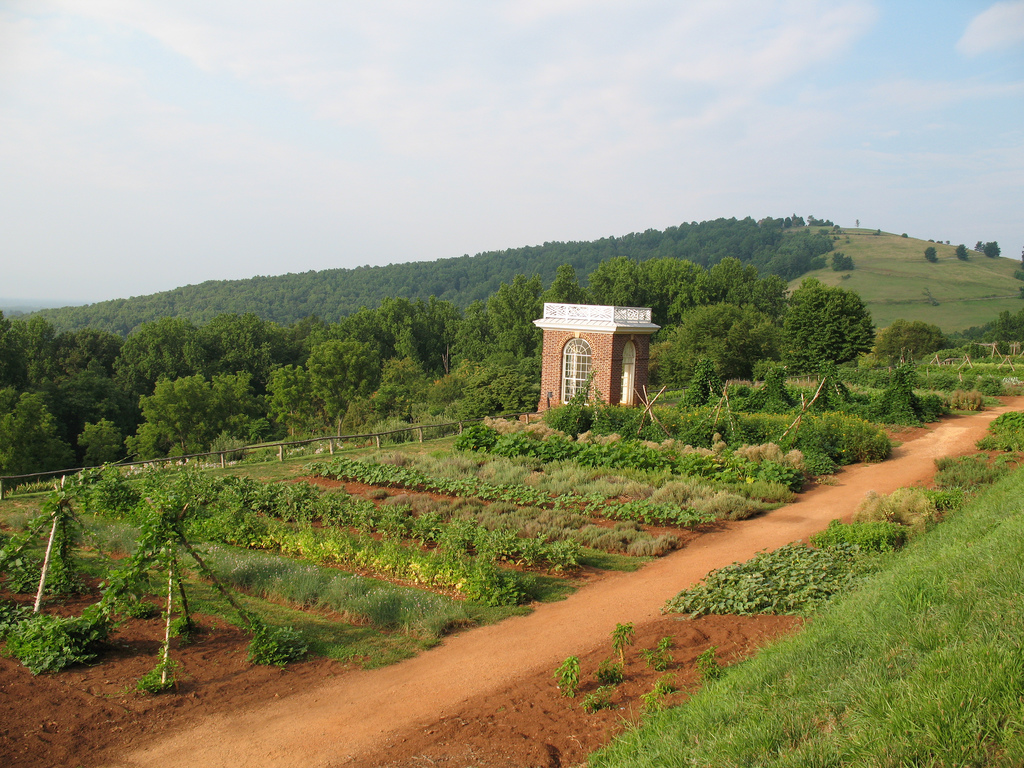
No occupation is so delightful to me as the culture of the earth, and no culture comparable to that of the garden
-Thomas Jefferson
Image credit: Mr. T in DC

To see Thomas Jefferson's writing, people have to visit a museum. To see vegetables from Jefferson's garden, people just need to plant them. Jefferson planted 330 vegetable varieties in his two-acre garden in Monticello and garden enthusiasts can purchase one of those varieties, the Bull Nose bell pepper at several seed retailers today.

Introduced to North America in 1759 from India, the Bull Nose became popular in the 1800s. Amelia Simmons mentioned the variety in American Cookery, the first cookbook written by an American.* The four-lobed pepper boasts a thick skin that ripens from green to red like most bell peppers, and has an interesting taste. The flat flesh is sweet while the inner ribs can be hot, but these variations of heat depend on growing conditions.

Image credit: Hozae

Several of these seeds are germinating and preparing for transplant into our pepper garden. Yes, I like peppers that much.

*I have to mention this quote about American Cookery from the Historic American Cookbook Project of Michigan State University: "The importance of this work cannot be overestimated. Its initial publication...was, in its own way, a second Declaration of American Independence."

Wednesday, March 13, 2013

Greasy Beans

(Phaseolus vulgaris)

First, they're not really greasy. They get the name from their smooth pods that lack the normal beanpod fuzz, then when they're cooked, they look greasy. There are something like 30 different varieties of greasy beans, mostly grown in the Appalachian Mountains in Kentucky and North Carolina.

Image credit: Hozae 

Greasy beans have interesting histories, from the Cherokee Greasy, still grown the the Native American reservation in Cherokee, NC, to the Lazy Wife, whose large beans grow in clusters, making them easy to pick. In 1907, the variety was the third most popular bean in the United States, according to Southern Exposure Seed Exchange. My favorite story about these beans is that Appalachian brides' wedding attire would usually include some seeds from their family's variety of greasy.

If you'd like to add a bit of hilltop heritage to your garden this year, you can find greasy beans at Secret Seed Cartel, an Ohio-based company, and several of the usual seed sellers.

For further reading, check out Hanna Raskin's entertaining article at Huff Post Food about greasy beans. Here are two of the great quotes:
"It's a muscular bean. When they're ripe, they just burst with delicious vibes."
"These are humble little hillbilly beans. But if chefs knew how to do something with them, they're feisty."

Tuesday, March 12, 2013

Chioggia Beet

(Beta vulgaris)

"Pre-1840 Italian heirloom, introduced to the U.S. before 1865. Named for a fishing town near Venice. Uniquely beautiful flesh has alternating red and white concentric rings that resemble a bull's-eye. A feast for the eyes; wonderful for fresh eating and pickling. Retains markings if baked whole and sliced just before serving." -Seed Savers Exchange

Image credit: Mason Masteka

Pronounced "chee-o-jah," this beet grows early and is known for its ability to compete with weeds. Its Italian name of Dolce Di Chioggia comes from its extreme sweetness—many people say these beets are sweeter than carrots. It's a popular seller and is widely available, listed in the three seed catalogs sitting on the table in front of me—Southern Exposure Seed Exchange, Sow True Seed, and Seed Savers.

Chioggia, Italy, called the little sister of Venice, seems to be a popular namesake for purple under-appreciated vegetables. It lends its name to a radicchio also.

Image credit: Andrea Sartorati

I've never liked beets, but when searching through the catalogs this season, I almost ordered this variety only in the hopes that I could pick one from our garden, slice it open and see those rings. Maybe next year.

Monday, March 11, 2013

Black-Seeded Simpson Lettuce

(Lactua sativa)

I planted my first heirloom variety four years ago, but didn't learn that it was actually an heirloom until a few months ago. Black-Seeded Simpson seeds were among the many plastic packets of seeds delivered to my wife and me by family friends who are expert gardeners one evening in spring 2009. I still remember how they backed down our driveway ready for action with their pickup full of horse manure and a rear-tine tiller.

Image credit: Kristen Bonardi Rapp

The father tilled our small garden bed (we've audaciously expanded it each year since) and gave us seeds for 10 or so varieties that had done well for them in their large garden. By "large" I mean that the family's annual Christmas letter always includes tallies of how many jars of each veggie variety the mother cans. The numbers are always impressive.

What's left of those first heirloom seeds given to my wife and me.

Anyway, one of the seeds they gave us was Black-Seeded Simpson, technically a loosehead type lettuce. That basically means that it doesn't form a head like Iceberg lettuce, but has delicate leaves that a gardener just pulls off the main plant. The neon green lettuce comes up fast, 40 to 55 days, and tastes great, not at all bitter. If you want fresh lettuce all summer, this is the heirloom for you. It grows so fast that a person could make himself a salad each day from one plant. This stuff is prolific—you'll likely end up with more than you can eat, so make friends with your neighbors. Burpee says the variety has been filling gardens for more than 150 years and I suppose that for many years into the future, friends will continue sharing the seeds of this easy-to-grow lettuce of yesteryear.

Sunday, March 10, 2013

Why heirlooms?

Why talk about heirloom vegetables? Aren't there hybrid seeds overrunning the aisles in the local farm store and ChinaMart? Don't hybrid seeds produce a huge yield and tolerate chemical fertilizer? Yes. They also grow uniformly in size and shape, develop tough skins to help them survive long-distance shipping, and they have extended shelf life. So why heirlooms?

Image credit: USDAgov

"If you are only transporting a tomato from the backyard to the kitchen table, you don't need a thick-skinned, tasteless fruit like the ones you find in the supermarket," Benjamin Watson writes in Taylor's Guide to Heirloom Vegetables. "Granted, any variety of tomato tastes better when grown and harvested vine-ripe at home, but why should home gardeners have to settle for the same high-test hybrids as the large commercial growers, who expect so much more (and so much less) from their vegetables?"

When I grew hybrid tomatoes in my backyard garden a few years ago, I could have bought the same tomato at the store, but it's tough to find a store selling Brandywine tomatoes, or Golden Bantam corn. Scientists will talk about how heirlooms do the crucial work of preserving genetic diversity, and I suppose someone sees the benefit in that, but the simple fact is that heirlooms offer more variety than do store seeds. And you can save seeds from your heirloom and replant them next year, enjoying the entire process--both the frustration and joy--of the growth cycle.

We have too many seeds. I'll bet 75 percent of these are worthless and wouldn't germinate.
For me, growing heirlooms is more fun than growing hybrids because not many of my friends can say that they're growing Forellenschluss lettuce or Alisa Craig onion. Heirlooms give old-time variety that's still prized today.

Saturday, March 9, 2013

What's an heirloom?

While "heirlooms" are family keepsakes that you can't throw away, there isn't a universally accepted definition of "heirloom plants." The broadest definition mandates that a plant variety meet three qualifications:

1. Able to reproduce itself from seed.
Most heirlooms are open-pollinated, meaning that they grow true to type from seed. On the other hand, seeds from hybrids are usually sterile or grow a plant true to one of hybrid's parent forms. The exceptions to the true-to-type rule are those plants that gardeners grow from cuttings or roots, such as potatoes, asparagus, onions, rhubarb, and garlic.

2. Must have been introduced at least 50 years ago.
Fifty years is just an arbitrary number--some heirloom lovers go by a 100-year rule.

3. Must have a history.
This is my favorite part of heirlooms. A variety of pole beans that may have been carried to America on the Mayflower, or cucumbers introduced in Philidelphia in 1928, or green dent corn planted by a pre-Columbian civilization in Mexico--these are heirloom plants. Plants that have a history.

Myself, I'm planting Bull Nose bell peppers this year. Thomas Jefferson planted them at Monticello.


 I need to give credit to Benjamin Watson, who wrote Taylor's Guide to Heirloom Vegetables, for most of the information in this post. The book is great and you should either buy it or check it out of your local public library and start racking up late fines.